

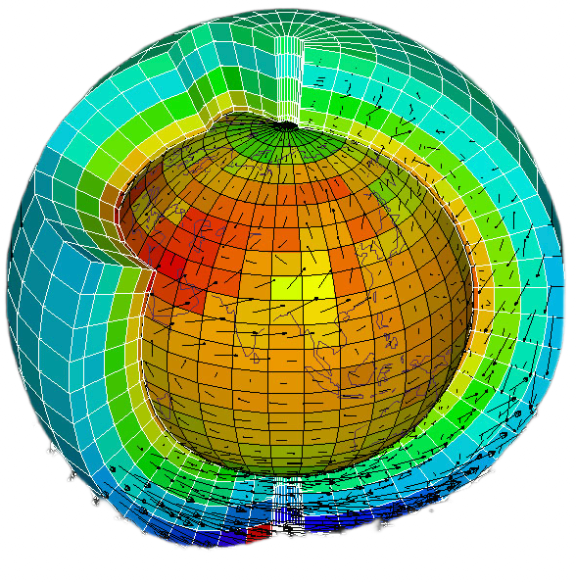
Interpreting Climate Stress Tests (SSP, RCP, GCM)
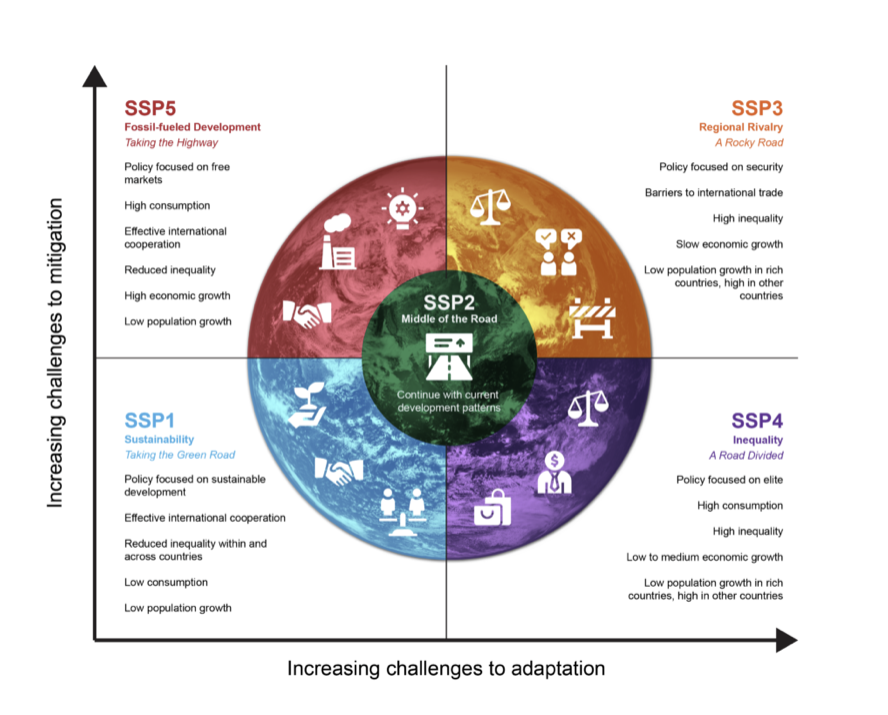
The five SSP-based scenario trajectories used in the CMIP6 models and the higher or lower challenges associated with them regarding the implementation of mitigation or adaptation strategies.
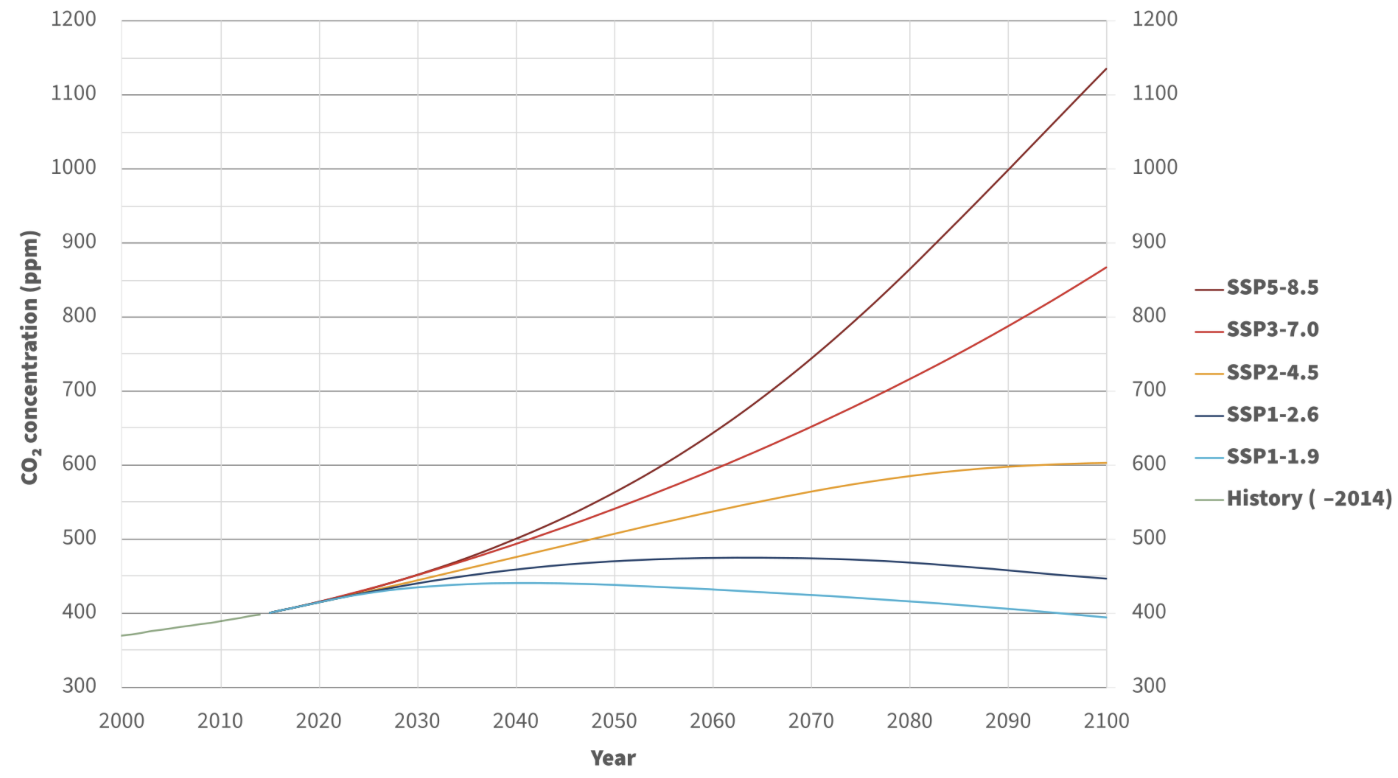
Shared Socioeconomic Pathway (SSP) - Predicted atmospheric CO₂ concentrations for different shared socioeconomic pathways (SSPs) across the 21st century (projected by MAGICC7, a simple/reduced complexity climate model). Each data point represents an average of simulated values generated from five integrated assessment models.
Tempest provides a range of climate stress tests for different warming scenarios.
These are based on linking current climate regulatory and reporting stress test requirements for various businesses to scientific climate models used to understand alternative future global warming scenarios.
Regulatory Stress Tests
Climate Stress Tests for regulatory reporting (e.g. Task Force on Climate-Related Disclosures / Corporate Sustainability Reporting Directive) typically require that companies assess resilience under multiple future climate scenarios. These scenarios relate to the potential collective actions (or inactions) of governments around the world to lower their GHG (GreenHouse Gas) emissions through the 21st century as we progress towards a low-carbon economy.
As there are many variations of future transition, regulators typically ask companies to consider the implications of each. These can broadly be categorised as follows;
‘Orderly’ transition - This sees governments respond collectively and early in the 21st century to limit their GHG emissions through expansion of renewable energy production, net zero regulation and incentives pricing. The aim being to limit global warming to between 1.5-2 degrees by 2100.
‘Disorderly / delayed’ transition - This sees governments delay their response or be slow to respond to the transition and assumes limited/no reduction on emissions until the 2030’s. In the meantime, GHG emissions continue to rise.
‘Hot House World’ - This worst case scenario is effectively a failed transition and assumes limited policy intervention, continued fossil fuel dependence and leads to an unabated rise in GHG levels through the 21st century.
Shared Socioeconomic Pathways (SSP)
Shared Socioeconomic Pathways (SSPs) are standardized future development scenarios used in climate modelling to assess how population growth, economic development, technology, energy use, and governance may influence greenhouse gas emissions, adaptation capacity, and climate risks. Developed by the International Panel on Climate Change (IPCC) as part of the sixth assessment report, SSPs support global regulatory and reporting standards such as TCFD, CSRD, and IFRS S2 by linking socioeconomic trends with warming outcomes.
As well as being a qualitative description of future scenarios of GHG emissions, SSPs are also interpreted through predictive climate modelling using General Circulation Models (GCMs). Scientific bodies around the world interpret each SSP by assuming different levels of GHGs. These alternative levels of GHG based on SSPs are known as Representative Concentration Pathways (RCP) and provide an input for GHG levels within models to see how the climate will respond. There are multiple combinations of SSP and RCP combinations (image opposite).
Of the SSPs, Tempest considers SSP 2 and SSP 5 as best reflecting current climate stress requirements for most regulatory reporting. These are highlighted below in green. SSP2, also termed ‘Middle of the Road’ is expected to see warming levels reach 2 degrees by 2050 and 3 degrees by 2100. ‘Taking the highroad’ (SSP5) is a worst case scenario and sees global warming reach over 5 degrees by 2100 and 2.5 degrees by mid-century.
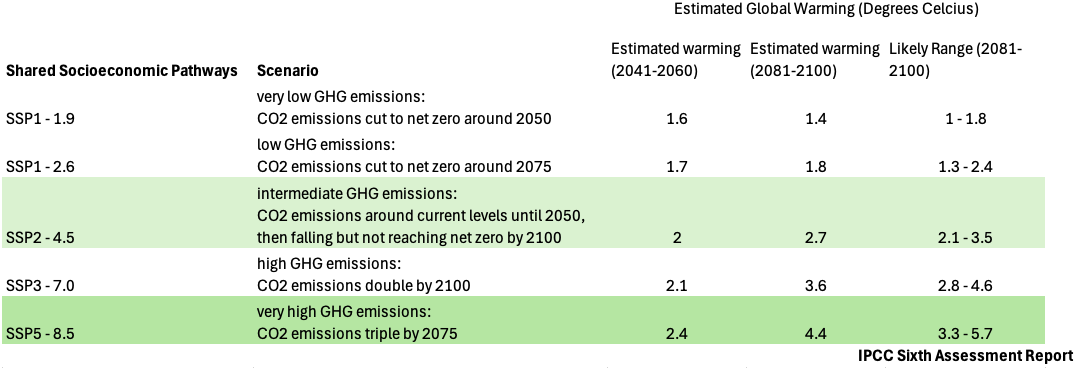
This table shows how SSPs related to global warming scenarios at mid-century (2050’s) and end of the century (2100)
Tempest Climate Change Modelling
Tempest uses output from the world’s leading General Circulation Model experiments, known as CMIP6 (Coupled Model Intercomparison Project 6), to understand how future climate extreme severity and frequency may change through the 21st century. This is done through Tempest’s research in processing the raw climate model data from multiple climate variables (e.g. Temperature, Humidity, Precipitation, Sea Levels) and understanding how these variables are impacting climate extremes (e.g. flooding, wildfire, hail).
There is no single process or methodology for this translation as climate models are highly complex and non-linear in their interpretation of future variables. Similarly, as GCMs are developed by regional climate agencies, they are noted as usually having higher levels of ‘skill’ closer to their core domain of interest. This is often term ‘regional bias’.
Similarly, there are large uncertainties in some climate variables compared to others. While GCM predictions of future temperature changes shows high correlation to observed changes, regional patterns of precipitation extreme are much more uncertain in GCMs. That said, Tempest follows best practice with regard to how each climate peril is interpreted.